Patient-Centred Experience and Digital Transformation Technologies
Summary
Every keynote, panel discussion, and research study now agrees: digital transformation is no longer optional for enterprises — it will permanently alter how consumers interact with products and services.¹ Digital transformation refers to the application of technologies such as mobile data analytics and smart embedded devices to reinvent customer relations and business processes. Worldwide spending on digital transformation is forecast to approach $4 trillion by 2027, according to IDC² — up from $2.5 trillion in 2024, with AI and generative AI now the primary drivers of that growth. Healthcare is no exception: the industry must modernize its processes to remain competitive, while simultaneously reshaping patient-care operations for a dynamic environment. Amid this push toward digital sophistication, the demand to place customer expectations at the centre of every service interaction has only intensified. Adopting a customer-centred mindset — built on human insight rather than on digital transformation for its own sake — remains the critical piece of the customer experience puzzle.
In the rush toward digital transformation, businesses often chase instant gratification through technology, hoping loyalty and revenue will follow — but this misses the point. Rather than treating digital transformation as the delivery mechanism for a better experience, businesses should build a customer experience strategy rooted in human insight. The better the experience, the more repeat business and positive reviews follow, while complaints and frustration decline.³
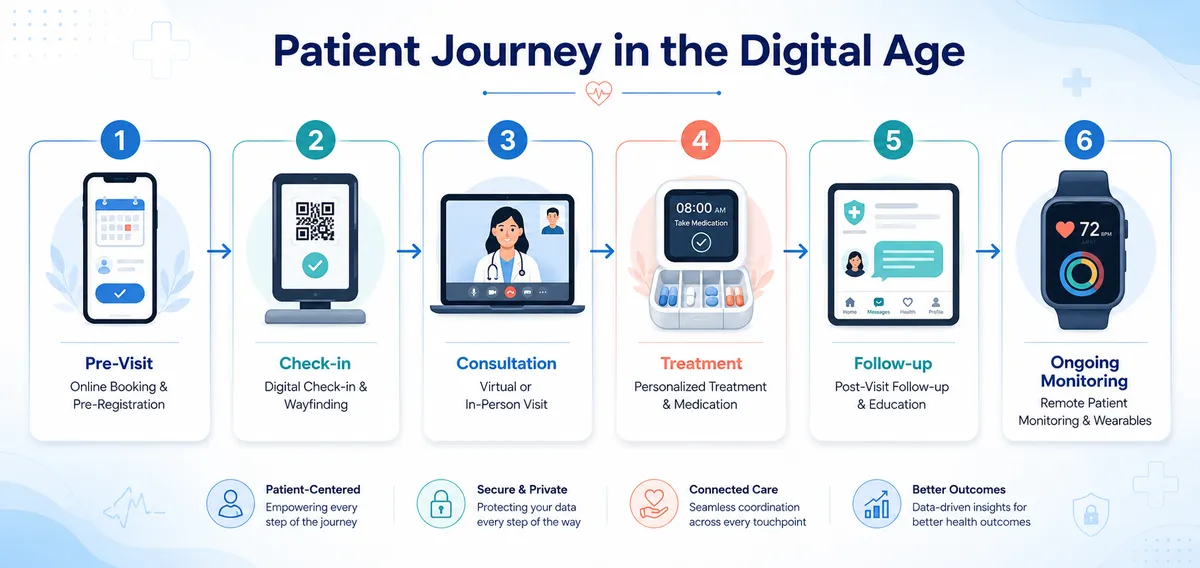
A visual overview of the digital patient journey, showing how connected technologies support patients across every stage of care—from pre-visit booking and consultation to treatment, follow-up, and ongoing monitoring.
So what should healthcare's strategy be for driving digital transformation from a genuinely patient-first standpoint? What must change — not just technologically, but organizationally — to meet patient needs and expectations? And critically: can technology alone solve problems that are fundamentally human? These questions can be explored by applying a structured, insight-led methodology — in this case, the R.A.C.E. framework.
Patient Needs Are Critical, and Often Forgotten
People in Ontario are, on average, seeing overall improvements in many aspects of their health, and in the care they receive. They are living longer and are less likely to die before the age of 75.
This is drawn from Measuring Up 2018, a report by Health Quality Ontario⁴ that tracks improvements in care quality and life expectancy across the province, with input from patients, families, doctors, nurses, and healthcare professionals. It serves as a barometer of what's working and what still needs attention — chief among the latter, unpredictable wait times at pharmacies and hospitals, a problem that has only deepened in the years since:
As of January 2026, patients admitted to hospital from the emergency department spent an average of 20.3 hours there before a bed became available — up from nearly 16 hours in 2017/18 — with only 26% of admitted patients meeting the province's 8-hour target.⁴ᵃ
At the 90th percentile, the picture is grimmer: as of May 2026, nine of ten admitted patients waited up to 44 hours for an inpatient bed, according to the Canadian Centre for Policy Alternatives' Failure, by Design report⁴ᵇ — a 52 per cent increase from 29 hours in 2020/21.
Wait-time challenges like this are rarely isolated failures — they are systemic. A systemic problem originates in the structure of the system itself, not in any single individual or event, which means every component of that system has to be treated as part of the solution. Addressing it requires looking at the whole system rather than patching the visible symptom; changing structure, policy, or organizational design tends to outperform quick fixes, and helps counter systemic bias — the tendency for a system to quietly favour certain outcomes over others.⁵
A system is a set of related components that work together in a particular environment to perform whatever functions are required to achieve the system's objective. — Donna Meadows
Beyond wait times, other operations are prime candidates for a patient-centred overhaul: caregiver distress, cervical cancer screening uptake, wait times for long-term care admission, wait times for surgery — all areas where inefficiency directly erodes patient trust. The goal is to reduce redundancy, streamline operations, and build systems accessible to all groups, while empowering healthcare professionals to meet patient needs both rationally and empathetically.
The real question is: how might we design a system that improves the quality of service for patients?
A R.A.C.E.-Based Approach to Patient-Centred Experience Design
Technology alone is an inadequate response to multi-layered patient-care challenges — pharmacy operations, medication consulting and dispensation, administrative processes, and the cultural context surrounding all of them. Closing the gaps in patient engagement means bringing diverse factors together under one collaborative approach to the delivery model and experience. That requires looking past surface-level interactions and into the core structures of healthcare delivery — from the perspective of human needs, behaviours, and emotions. It is this lens that lets an organization empathize not just with patients, but with the staff delivering care, and widen its scope of innovation beyond cosmetic, technology-only fixes.
The original five-phase design-thinking model borrowed structure from generic design-thinking practice, but did more to justify a process than to drive one — it never asked what a healthcare organization specifically needs from each stage, only what a design workshop typically produces. The R.A.C.E. framework — Research, Advisory, Conceptualize, Educate — corrects that: each phase is defined by a distinct work product and a distinct question it answers, not by a workshop activity.
How might we transform the in-store pharmacy experience and the digital interactions around it?
Research
A preliminary analysis of the pharmacy's systems, resources, and environment exposes the fault lines — the points where the organization's assumptions about how patient care happens diverge from how it actually happens on the floor. This is where the questions no other function is asking get asked: Who are the patients, caregivers, and staff this system actually serves? How do they currently navigate consultation, dispensation, and follow-up? Where does the existing process generate overhead, workaround, or quiet resistance from the people using it daily? Mapping the patient's touchpoints — digital, physical, and emotional — against these questions turns anecdote into evidence, and gives the phases that follow something concrete to work from.
Advisory
The insights gathered in Research are examined here for pattern and implication. By this stage, the friction is evidently proven — an unpredictable wait time, a duplicated intake step, a hand-off that loses information between pharmacist and patient — but proof is not the same as understanding. Advisory determines where that friction actually lives: whether it originates in the system, in the management structure governing it, or in both; who within the organization is absorbing its cost, whether that is the pharmacist's time, the patient's trust, or the caregiver's burden; and what level of intervention the problem genuinely requires, rather than the level of intervention that happens to be easiest to fund.
Conceptualize
Here, design prototypes and validated findings translate analysis into testable responses. Co-creation sessions bring patients, caregivers, pharmacists, and healthcare professionals directly into the ideation process — not as research subjects, but as contributors evaluating and refining live proposals. The abstract finding from Advisory becomes a concrete artifact: a workflow redesign, a consolidation of duplicated systems, or a specific process change, built and rapidly prototyped so it can be tested rather than merely argued for.
Educate
Educate is the accountability function made explicit. It is the point at which research findings, analytical insights, and prototyped proposals — validated through structured testing across real touchpoints — are presented to the project and management teams, not as a design deliverable, but as organisational intelligence. Its purpose is to make the invisible visible: to give the people with the authority to act a clear, evidenced account of where friction exists, what it is costing, and what addressing it would require. Whether they act on that intelligence is their decision. That they have it, clearly and without ambiguity, is design's responsibility.
Designing a Patient-Centred Experience at Mayo Clinic
Digital transformation helps organisations centralise and access data, enabling agility, innovation, and efficiency.⁶ But the tendency to conflate digital transformation with customer experience is precisely why so many transformation efforts fall short.
The human-centred approach underpinning design thinking already has strong precedent in healthcare. The Mayo Clinic used design thinking to establish its SPARC Innovation Program in Rochester, Minnesota — a research-and-development lab dedicated to health services.⁷ Its purpose was to examine how patients actually experience healthcare, and Mayo's willingness to question every step of the existing workflow — asking the right questions before proposing solutions — allowed it to identify specific, addressable gaps and build a culture that did not just tolerate disruption to old habits, but relied on it.⁸
Designing a genuinely patient-centred experience requires more than good intentions: a dedicated innovation lab, capital committed to design-led work, and people willing to challenge the status quo — practitioners comfortable gathering insight, prototyping, and refining ideas alongside the people they are designing for. Above all, it requires healthcare organisations to commit, structurally and continuously, to converting human insight into innovation that compounds over time.
Let's talk about a complex problem.
If you're navigating a transformation, enterprise design challenge, or organizational problem where the answer isn't obvious, let's explore it together.
Footnotes
Worldwide Spending on Digital Transformation is Forecast to Reach Almost $4 Trillion by 2027 — IDC (updated from original 2019 source, which cited a since-passed $2 trillion by 2022 projection)
4a. Time Spent in Emergency Departments — Ontario Health (current data, January 2026; same "length of stay for admitted patients" metric as the original 2018 source, updated to show the trend over time)
4b. Failure, by Design: A Report on Ontario's Hospital Funding and Emergency Department Crisis — Canadian Centre for Policy Alternatives (May 2026 report by Andrew Longhurst examining emergency department performance, hospital capacity, and systemic barriers to patient-centred care in Ontario. Presents 90th percentile wait times for admitted patients waiting for inpatient beds.)
Tools for Systems Thinkers: The 6 Fundamental Concepts of Systems Thinking
Health Care Providers Can Use Design Thinking to Improve Patient Experiences
Lessons from the Mayo Clinic: Can design thinking help global health delivery?