Why Wait Estimates Lie, and How to Fix Them
I accompanied a family member to a diagnostics lab for blood work, expecting a short visit. I left after more than ninety minutes, tired, hungry and relieved, which is not the same as satisfied. To make sense of it, I mapped the visit in an experience map across six stages. My emotion ratings, from 1 to 5, ran 1, 3, 1, 3, 4, 5. Details have been generalized to protect the privacy of the person I accompanied.
| Journey stage and rating | Experience |
|---|---|
| Arrival and check-in (1) |
I joined the line with no idea how long it would take or where I stood. Walk-ins and appointment patients shared the same space, and about 45 minutes passed before a staff member called us to the desk. I had forgotten a document, and the staff member registered us anyway, which I appreciated. But voices carried across the room, which undercut the lab's gestures toward privacy, and the card machine was down, so payment had to wait. |
| Reading the dashboard (3) |
A TV screen listed every patient with an ETA, ranked from lowest to highest, with clear icons separating walk-ins from appointments. I will admit I liked it. For a moment I felt oriented, and our slot showed about ten minutes. |
| The wait (1) |
Then the numbers began to move. Appointment patients arrived for their slots and were served first, so every walk-in estimate slid. Ours went from 10 minutes to 25, with no assurance that it would hold. Even the first-ranked walk-in waited over an hour. At one point our name vanished from the list, and I had to confirm with the receptionist that we were still in the queue. Patients who asked about booking were told, rudely, that appointments could only be made online. The room was crammed and the lab looked short-staffed. Even appointment patients waited because there were too few cubicles and too few people to draw blood. There were more people standing than sitting, many of them seniors, and there was no washroom or drinking water inside. People who were not patients came in asking for money, twice. The crowd spilled toward the entrance, and staff asked some patients to wait outside. My body ached, and I had no choice but to keep waiting. |
| Getting called (3) |
I was called midway to pay for a test and thought our turn had come. In a crowd that size, I had to strain to be sure I heard our name when it was finally called. |
| Receiving the service (4) |
After all that, we still waited another 10 to 15 minutes inside the cubicle for a staff member to be assigned. Then someone arrived who spoke our language in a friendly tone, and the long wait outside suddenly felt worth it. |
| Leaving (5) |
We were free to go, and I felt relief. My note to self was to book online and carry the right documents next time. |
What the map shows
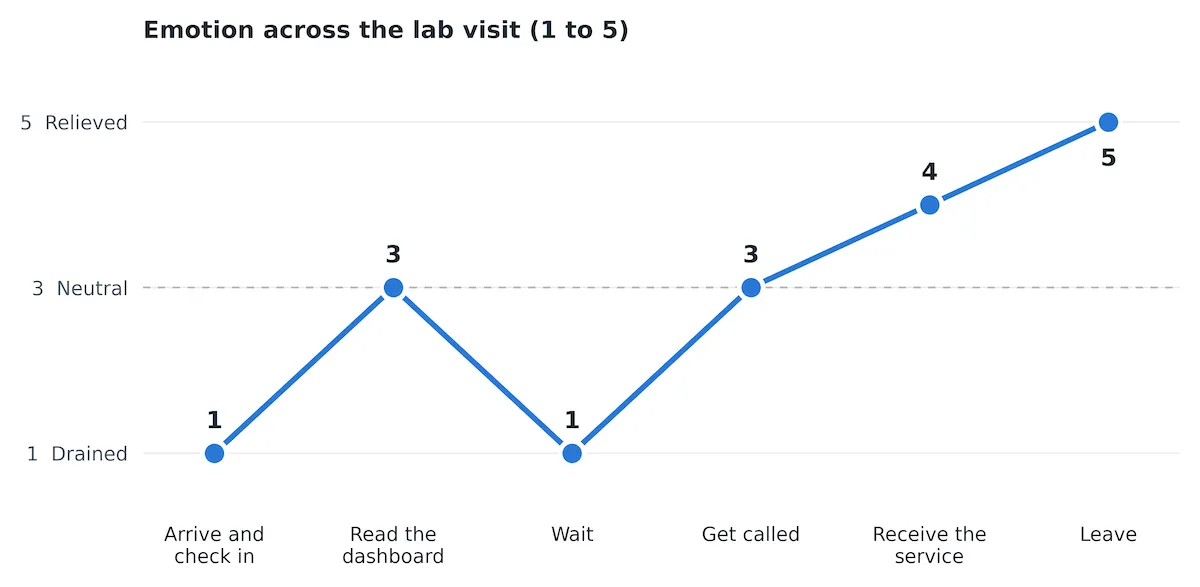
Fig.: 1: Line chart of emotion ratings across six stages of the lab visit, starting at 1, rising to 3, dropping to 1 during the wait, then climbing to 3, 4 and 5
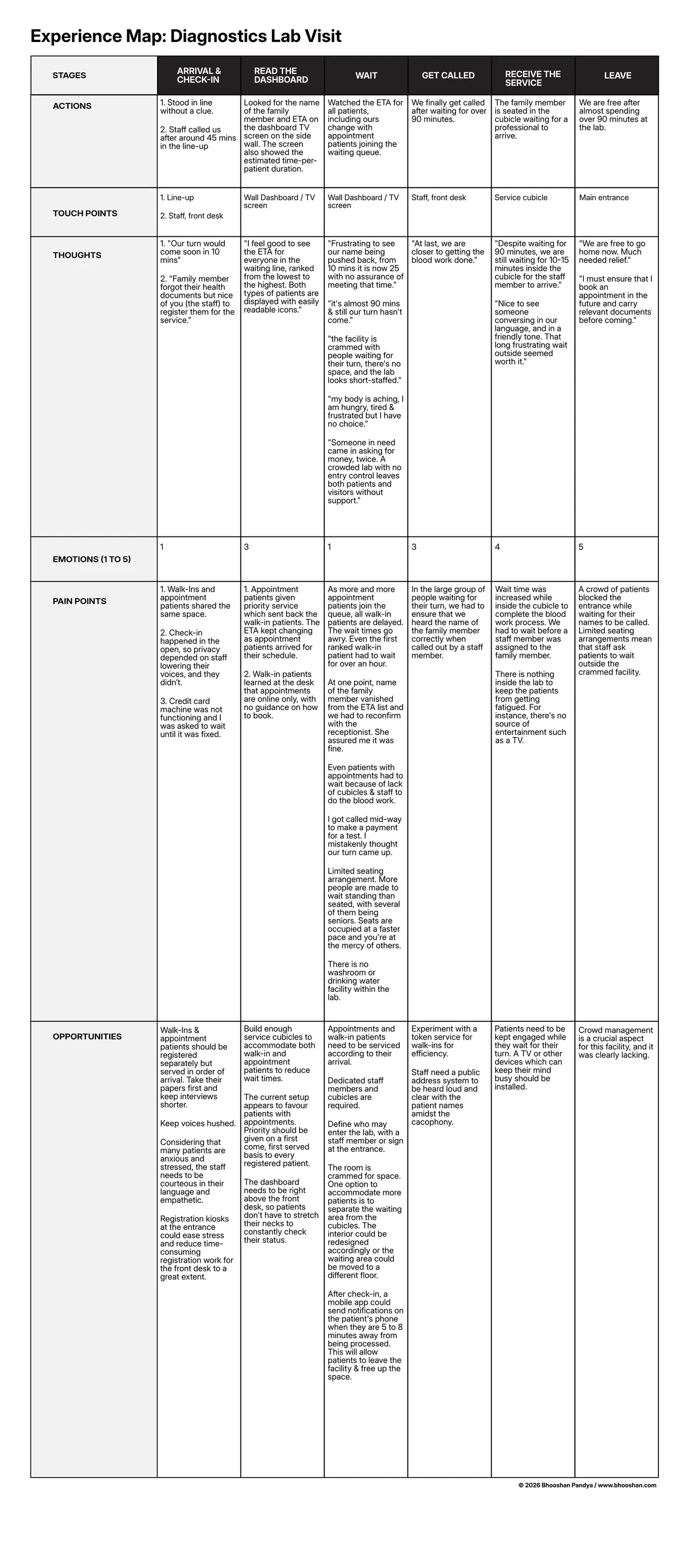
Fig. 2: Experience map of a diagnostics lab visit across six stages, with actions, touchpoints, thoughts, emotion ratings, pain points and opportunities
The dashboard was a good idea sitting on a broken capacity model. An ETA is a promise. When appointment patients have guaranteed priority and walk-ins are served from whatever capacity is left, every walk-in estimate is a guess that expires each time someone with a slot arrives. The system showed me a number it had no way of keeping.
The curve also shows how much one warm human moment can lift an experience. But a 5 at the end of my map is relief, not delight, and a service that depends on patients being grateful the ordeal is over has a design problem.
What I would change
These are the ideas on the table, and they are not equally urgent. Further down, I sort them by effort and impact and describe how I would test the strongest ones.
- Serve patients on a first come, first served basis, whether they walk in or have an appointment, with enough cubicles and staff to handle both
- Where space allows, mark out clear zones in the waiting area so patients know where to wait and how the queue works
- Collect paperwork first and keep interviews short
- Test a token system so walk-ins are served in order of arrival
- Move the dashboard screen right above the front desk so patients don't have to crane their necks to read it
- Add self-registration kiosks so staff can spend their time on the floor
- Develop a mobile app with free sign-up, so patients can register or check in remotely and get a notification when their turn comes
- Use a public address system so names are heard over the crowd
- Train staff to show empathy and courtesy, and to be ready to offer information and assistance when patients need it
- Provide enough seating and drinking water
- Install a separate TV in the waiting area, running news or food channels, to keep waiting patients engaged
- Keep non-patients out of the facility
Patients often cannot take their business elsewhere, so the design has to earn their trust instead.
Where I would start
If I could change only a few things, I would sort the ideas by effort and impact, and I would fix the promise before I fixed the space.
| Focus and timeframe | Actions |
|---|---|
| Fix the promise Days to weeks |
Serve everyone on a first come, first served basis, and say so on the screen and at the desk. Show a time range, not a single number, with a short reason whenever the estimate moves. Move the dashboard right above the front desk so patients can read it without craning their necks. |
| Fix the floor Weeks to a few months |
Add a public address system, courteous and informative front desk scripts, and clear entry rules. Provide enough seating and drinking water, and a TV to ease the wait. Collect paperwork before the interview and keep interviews short. |
| Fix the system Months |
Launch a mobile app and entrance kiosks so patients can register early and get a notification when their turn is near. Match cubicles and staff to the arrival pattern of both walk-in and appointment patients. Redesign the waiting area, with clear zones if space allows. |
The same visit, redesigned
Here is how the same visit could feel with those changes in place. I would register at a kiosk, or already have checked in on the app. The dashboard above the desk would list everyone in order of arrival, with a range instead of a promise, and it would tell me why if the range shifted. Knowing that I had time, I would sit, or step outside, until my phone said my turn was five to eight minutes away. A clear voice would call the name, the cubicle would be ready and a courteous staff member would start right away.
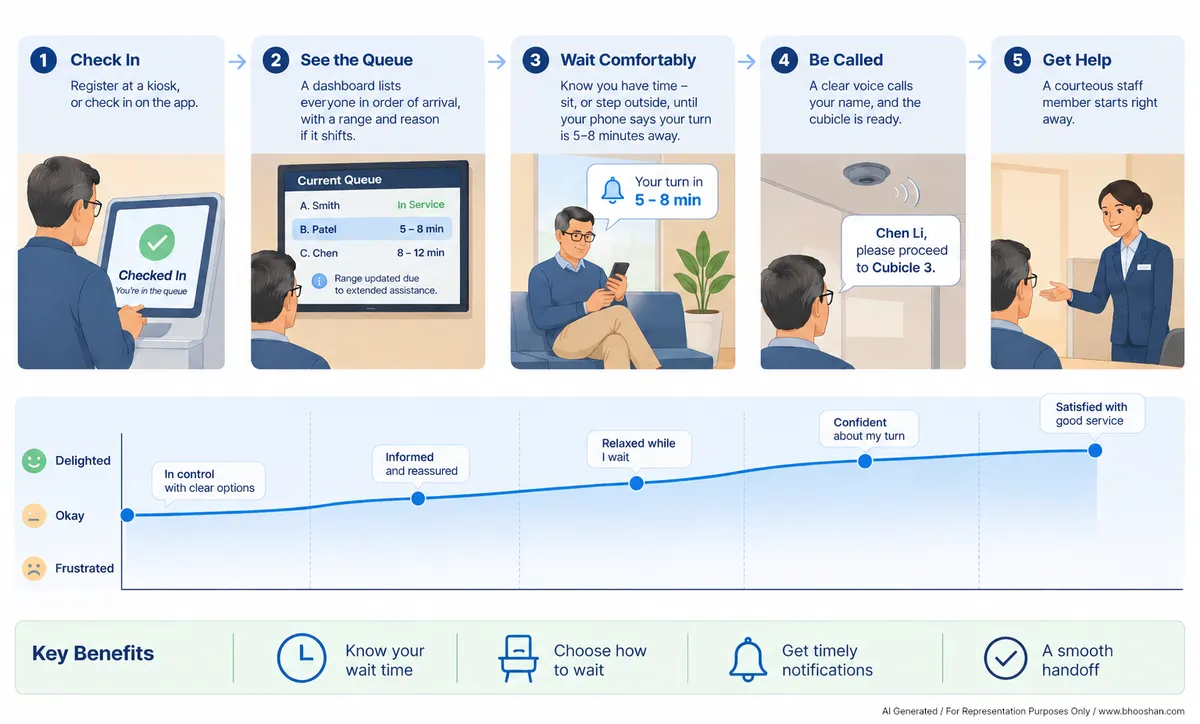
On the experience map, the emotion curve would stop falling to a 1 during the wait, and the relief at the end would come from a good service, not from the ordeal being over.
How I would approach it
The experience map shows what one visit felt like from the patient's side. It cannot explain why the queue behaves the way it does, because the causes sit behind the front desk, in scheduling, staffing and the rules that drive the dashboard. Research observes and Advisory judges, so the next step would be to look behind the desk. Here is how I would apply the RACE framework (Research, Advisory, Conceptualize and Educate) to this lab's patient flow over about six weeks. I would focus on the flow from arrival to departure and leave clinical procedures and lab analysis out of scope.
What I would test first
The map is one patient's account of one visit, so I would treat it as a set of hypotheses to test, not a set of conclusions.
- Appointment slots may leave no capacity for walk-ins, so every walk-in ETA expires when a scheduled patient arrives
- Appointment and walk-in patients may share the same cubicles and staff
- The dashboard may calculate ETAs without accounting for scheduled arrivals
- Check-in, payment and waiting space may add delays of their own
What I would aim for
- Make wait estimates trustworthy
- Reduce unplanned walk-in waits without penalizing appointment patients
- Ease crowding and stress in the waiting area
- Give staff clear rules and tools they can apply under pressure
The six weeks, phase by phase
| Phase and timeframe | Activities and outputs |
|---|---|
| Research Weeks 1 and 2 |
|
| Advisory Week 3 |
|
| Conceptualize Weeks 4 and 5 |
|
| Educate Week 6 |
|
What could get in the way
The recommendations address more than the visible wait: they may require new spending, changes to established routines and decisions beyond the lab’s control. These challenges could affect how quickly the client can act and which improvements are practical.
- Budget. The app, kiosks, extra cubicles and a waiting-area redesign all cost money, and the lab may not see a return.
- Staffing. More cubicles only help if there are people to run them, and hiring and training take time.
- Decision Rights. The lab may not control its own scheduling rules, space or technology—for example, if a head office or landlord decides.
- The Booking Model. Appointment priority may protect revenue or commitments, so first come, first served could meet resistance.
- Technology & Privacy. The dashboard’s ETA logic may be hard to change, and an app that handles patient information raises health privacy questions.
- Adoption. Some patients, especially seniors, may not use an app.
The Research phase would need to confirm what is feasible, but the biggest wins may not depend on a large budget. In the Advisory stage of RACE, I would separate these quick wins from changes that need investment, and make the case for acting by showing what the current wait costs in complaints, staff stress and lost goodwill.
How I would measure success
- Gap between the ETA shown and the actual walk-in wait
- Median and longest walk-in waits, against the baseline from week 2
- Crowding at peak times
- Staff confidence in the rules
- Patient comments on communication and comfort
A note on privacy
I would collect no patient names, test details or health information, and I would not record people during observation. Staff interviews would stay confidential and be reported in aggregate, because the work examines the system and not individuals.
If your organization has a queue like this one, whether in healthcare, retail or public services, I would be glad to talk.
Let's talk about a complex problem.
If you're navigating a transformation, enterprise design challenge, or organisational problem where the answer isn't obvious, let's explore it together.