Why Expert Review + Prototype Is More Persuasive Than Usability Testing Alone
The Target Date Comes First
Consulting engagements do not begin with a research plan. They begin with a deadline.
By the time a consultant is brought in, the brief is limited, the objectives are loosely defined, and internal client teams are often working from different versions of the problem. Design decisions stall not because the answer is unclear, but because the organisation has not agreed on what question it is asking. Above all, the engagement starts with a target date. What actually went wrong gets discussed afterward.
This ordering has consequences for method. The time needed to diagnose the problem is consumed before research even begins — by negotiation, by mapping gaps in the client's delivery process, by working around platform and organisation constraints that were never documented. What remains for validation is a fraction of what a textbook process requires.
This is the actual origin of the Expert Review + Prototype framework. Expert review followed by prototyping is not a preference for a leaner methodology. Instead it is the direct consequence of a schedule set before the problem was understood. Usability testing, when implemented accurately, needs time and structure which the engagement has already spent. Expert review does not.
The False Choice
The standard objection deserves to be stated plainly: expert review is subjective, usability testing is empirical, and empirical evidence should carry more weight than one professional's judgment. On the terms of a rigour contest1, 3, usability testing wins. It involves real target users. It surfaces mental models, emotional reactions, and unexpected failures that no amount of heuristic inspection will catch, because those things only exist in contact with an actual person using the actual product.
But a consulting engagement is not a rigour contest.
The client did not hire a consultant to settle a methodological debate. They hired one because a project has stalled, it is losing money or momentum every day it remains stalled, and someone needs to find the missing piece that gets it moving again. The choice between expert review and usability testing is not a choice between a weaker method and a stronger one. It is a choice between a method that fits the constraint the client is operating under, and one that doesn't.
This is where the persuasion argument lives. Expert review plus a prototype does not out-argue usability testing on evidence — conceding that openly is more credible than pretending otherwise. It persuades because it answers the question the client is actually asking, which is rarely "what is most valid" and almost always "how quickly can we get unstuck." A consultant who insists on the more rigorous method when the brief calls for speed is not being thorough. They are answering a question nobody asked.
Expert Review vs. Usability Testing
The structural differences between the two methods explain why one fits a compressed timeline and the other resists it.
Usability testing requires real target users — five to eight per round, sometimes more. It requires screening, scheduling, briefing moderators, running sessions, then analysis. When it is done properly, it produces rich qualitative data: task success rates, mental models, emotional reactions — findings that only surface when a real person meets the real interface. This is genuine strength, and the reason usability testing carries the highest ecological validity of any method available to a consultant. It shows what actually happens, not what is likely to happen.
Expert review asks for none of this. An experienced usability professional — sometimes a single consultant, sometimes a small group comparing and calibrating findings — inspects the interface against established heuristics, most commonly Jakob Nielsen's ten principles. No target users are recruited. No moderators are briefed. In some cases, the client's own employees can stand in as reviewers if needed. The review runs against wireframes, early prototypes, or a live system, at whatever stage the engagement happens to be in when the consultant is brought on.
The cost and speed difference follows directly from this. Usability testing requires a budget line for recruitment, moderation, and often incentives for participants — a budget that was rarely allocated at the outset of a stalled consulting engagement. Expert review requires the time of one experienced reviewer, and can turn around in days, not weeks.
None of this makes expert review the more valid method. It makes it the more available one — and in a fast-paced engagement, availability is not a consolation prize. It is often the only method that fits inside the constraint the client is actually operating under.
Why It's Persuasive, Specifically
Persuasion here does not mean winning an argument about method. It means producing something the client believes in, acts on, and moves forward with — fast enough that the stalled project starts moving again.
It would be convenient to argue that expert review is persuasive because it makes usability testing more targeted, or because the resulting prototype makes findings stick emotionally in a way raw data cannot. Both of these theories may be true in individual cases. But neither is the actual reason clients find this combination compelling, and claiming otherwise would overstate the argument.
The real reason is simpler, and less flattering to methodology itself: clients are largely indifferent to which method a consultant uses, as long as the project moves in the right direction. They are not weighing the evidentiary strength of expert review against usability testing. They are asking whether the bottleneck is going to clear, and how soon.
A more rigorous method that arrives after the client has already lost another week of momentum is not more persuasive — it is simply late. A less rigorous method that names the flaw, proposes a fix, and shows that fix working within days is what moves a stalled decision forward. The client is persuaded not by the strength of the method, but by the fact that something concrete now exists where nothing did before.
This is also why the prototype cannot be separated from the review. The review alone produces a list of findings — credible, but abstract. It is the prototype that turns those findings into something a room full of people with competing priorities can look at, agree on, and greenlight. The persuasion does not happen in the review. It happens in the room, in front of the prototype.
The Prototype's Role
A prototype is not simply the output of the review process. It is the artefact that makes the review's findings usable by people who were not in the room when the review happened.
The review itself is a distilled exercise. A single reviewer, or a small group, inspects the interface against established heuristics and produces a set of findings — often after interviews, task-flow mapping, and inquiries with the project team to understand how each flaw maps to a real user's mental model.
Those findings, on their own, remain abstract to most of the people who need to act on them. A list of heuristic violations does not tell a stakeholder what the fixed experience will feel like. A prototype does.
This is the prototype's actual function: it lets a team member — someone who was not part of the research, someone with a different priority in the room — look at a proposed fix and form an opinion about it immediately. No translation is required.
This matters more in a consulting engagement than elsewhere, because internal teams often arrive with conflicting versions of the problem. A prototype gives them one shared object to react to, instead of a document each side reads differently. It also invites feedback while changes are still cheap to make, before the product goes into full production.
The prototype does for stakeholders what the review did for the consultant: it replaces a debate over abstractions with a decision about something concrete. That is what makes it persuasive, and that is why it cannot be treated as an afterthought — it is the review's delivery mechanism.
When to Lead With This Combination
Three conditions, drawn consistently across engagements, signal that expert review plus prototype should lead.
Time constraints. The engagement starts with a target date already set. There is no room in the schedule for recruitment, screening, and moderated sessions before a decision is needed.
Budget constraints. The client was not expecting to fund usability testing. The engagement was framed as clearing a bottleneck, not commissioning research — and that framing rarely changes once the consultant is on board.
Design maturity gap. The client organisation does not yet have the internal fluency to see usability testing as central to the outcome. Asking for it upfront would slow the engagement down without building the trust needed to justify the ask.
Where none of these hold — where time and budget allow it, and the client already values empirical validation — usability testing remains the stronger choice. The framework is not a replacement for usability testing. It is what a consultant reaches for when the engagement's own constraints have already ruled testing out.
The Checklist
Every expert review needs a consistent basis for evaluation, or its findings vary by reviewer and lose credibility. Jakob Nielsen's ten usability heuristics provide that basis:
Jakob Nielsen’s 10 Usability Heuristics2
| # | Heuristic | Description | Evaluation Question (for reviewers) |
|---|---|---|---|
| 1 | Visibility of system status | The system should always keep users informed about what is happening through appropriate feedback within a reasonable time. | Does the UI show feedback within a reasonable time? |
| 2 | Match between system & real world | The system should speak the users’ language, with words, phrases, and concepts familiar to the user, rather than system-oriented terms. Follow real-world conventions. | Are words, phrases, and icons familiar and natural? |
| 3 | User control & freedom | Users should be able to undo and redo actions, and easily exit unwanted states. Provide a clearly marked “emergency exit” to leave an unwanted state. | Can users easily undo actions or get out of a mistake? |
| 4 | Consistency & standards | Follow platform conventions. Be consistent within the product and with external standards. | Is the UI consistent across screens and with external standards? |
| 5 | Error prevention | Prevent errors from occurring in the first place. Design the system so that users cannot make serious mistakes. | Are there preventive measures (e.g., confirmation dialogs, constraints)? |
| 6 | Recognition rather than recall | Minimise the user’s memory load by making objects, actions, and options visible. The user should not have to remember information from one part of the dialogue to another. | Are options visible or easily retrievable instead of relying on memory? |
| 7 | Flexibility & efficiency of use | Provide accelerators for the expert user. Allow users to tailor frequent actions. Cater to both novice and experienced users. | Does the interface support both beginners and power users? |
| 8 | Aesthetic & minimalist design | Dialogues should not contain information which is irrelevant or rarely needed. Every extra unit of information competes with the relevant ones and diminishes their relative importance. | Is the UI clean, uncluttered, and focused on relevant content? |
| 9 | Help users recognise, diagnose & recover from errors | Error messages should be expressed in plain language (no codes), precisely indicate the problem, and suggest a constructive solution. | Are error messages helpful, constructive, and actionable? |
| 10 | Help & documentation | Provide help and documentation that is easy to search, focused on the user’s task, and not too voluminous. Even better if it can be searched in real time. | Is help easy to find and relevant when needed? |
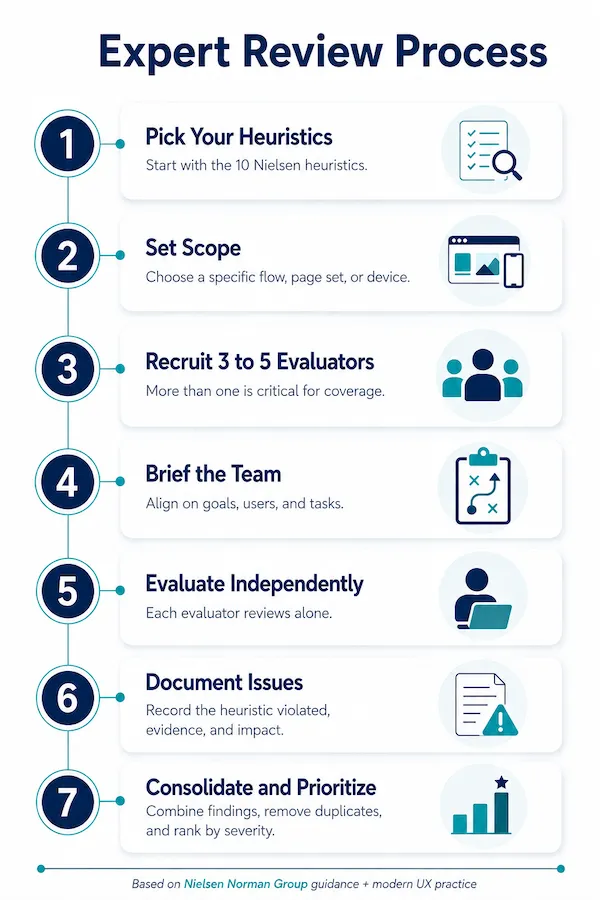
The expert review process in practice — from selecting heuristics to prioritizing findings for the client.
These heuristics are a starting point, not a substitute for judgment. Each engagement introduces its own constraints — platform limitations, industry regulation, the specific task flows under review — and the checklist should be adapted accordingly. What stays fixed is the discipline of reviewing against a named, repeatable standard, rather than a reviewer's unstated instinct.
Conclusion
Expert review plus prototype does not out-argue usability testing on evidentiary grounds. It was never meant to. It answers a different question than the one usability testing is built to answer — not "what is the most valid finding available," but "how quickly can this project move again."
That is the whole framework: a review finds the problem cheaply, and a prototype sells the fix persuasively. Everything else is a client organisation deciding, together, in front of something they can actually see.
Let's talk about a complex problem.
If you're navigating a transformation, enterprise design challenge, or organisational problem where the answer isn't obvious, let's explore it together.
Footnotes
- A “rigour contest” (also spelled “rigor contest”) is a formalised competition between different usability evaluation methods. It compares two or more methods (e.g., expert review / heuristic evaluation vs. usability testing) on the same interface using identical criteria to see which method is more effective:
- 10 Usability Heuristics for User Interface Design — Jakob Nielsen
- Famous “Rigour Contest” Studies
| Study | Year | Methods Compared | Key Finding |
|---|---|---|---|
| Jeffries et al. | 1992 | Heuristic evaluation vs. user testing | Experts found more problems; users found more severe ones. |
| Desurvire et al. | 1992 | Heuristic evaluation vs. user testing | Experts found more, but user testing found unique issues. |
| Gray & Desurvire | 1992 | Inspection vs. user testing | User testing problems were rated as more severe. |
| Hartson et al. | 1996 | Inspection vs. user testing | User testing problems had higher validity. |
Source:
These findings are drawn from classic comparison studies presented at the CHI conference and summarised in Nielsen Norman Group articles on usability inspection methods.