TELECOMMUNICATIONS
Simplifying Digital Self-Service Experiences
Overview
Telecommunications products often need to serve very different audiences: consumers managing their services and business users configuring or managing commercial offers. Although these users operate in different contexts, both need interfaces that make complex tasks understandable and efficient.
In this engagement, I contributed to UX review and UI design for a telecommunications provider's consumer self-care portal and business-facing offer-management application. The work focused on understanding user needs, simplifying information presentation, and aligning interface design with the tasks users needed to complete.
The challenge
The engagement involved two related but distinct experience challenges.
The consumer self-care portal needed to accommodate the needs and motivations of Indian telecom users. Understanding differences across user groups was important to making the experience relevant and intuitive.
The business-facing offer-management application presented a different challenge: its interface needed to support functional requirements, including drag-and-drop capabilities, without becoming unnecessarily complex for business users who were not necessarily technically oriented.
Across both experiences, the key challenges included:
- Different user needs: Consumer and business audiences required experiences shaped around their respective goals and contexts.
- Interface complexity: The design needed to remain intuitive while accommodating the application's required functionality.
- Content clarity: Information needed to be organised and presented in a way that users could understand.
- Task efficiency: Navigation and interactions needed to help users complete their key tasks without unnecessary complexity.
The challenge was to make the applications easier to understand and use without losing sight of the underlying business functions.
My role
I contributed UX and UI design expertise across the self-care portal and offer-management application. My work included reviewing the existing experience, helping clarify user needs, developing personas, and shaping interface concepts around business and user objectives.
I also worked on the information architecture and interaction design, translating the findings into more intuitive content structures and interface approaches.
Engagement approach
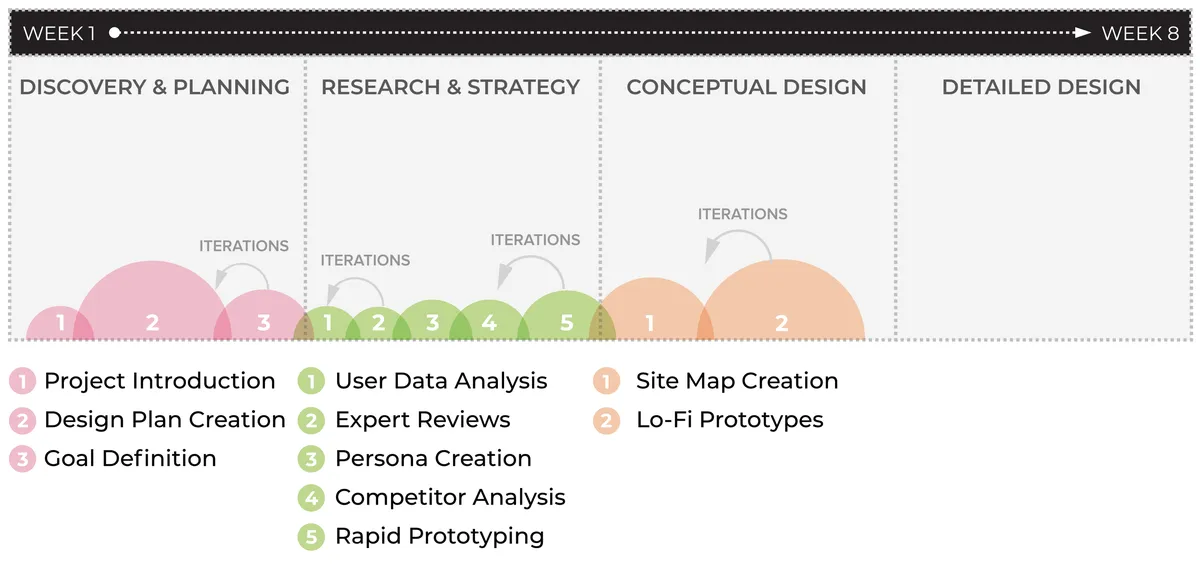
Engagement overview: understanding users, reviewing the experience, and translating findings into interface design recommendations.
1. Understand user groups and motivations
For the consumer self-care experience, persona design was used to develop insights into the demographics and motivations of Indian telecom users. This helped make user differences more explicit and provided a basis for considering how the portal should support its audience.
For the business-facing application, the design challenge centred on enabling users to work with the application's functions while keeping the interface accessible to non-technical business users.
2. Review information architecture and interaction patterns
The review considered how information was organised and how users would navigate the applications. The aim was to make content easier to interpret and to align the interaction model with the tasks users needed to perform.
This included considering how drag-and-drop functionality could be incorporated into the offer-management interface without compromising clarity or ease of use.
3. Translate insights into interface design
The findings informed UI design recommendations focused on simplifying the experience, clarifying content, and making key tasks easier to follow. The work connected user understanding and information architecture with practical interface decisions, rather than treating visual design as a separate layer.
Deliverables and strategic significance
The engagement combined user-focused analysis with design recommendations for two different telecommunications applications.
Key contributions included:
- User personas: Insights into the demographics and motivations of consumer self-care users.
- UX review: Identification of opportunities to improve the experience and better align it with user needs.
- Information architecture and content structure: Recommendations to make information easier to understand and navigate.
- UI design: Interface concepts intended to simplify interactions while accommodating required functionality.
- Business-facing interaction design: Consideration of drag-and-drop functionality and the needs of non-technical business users.
The broader significance was the application of user-centred design across different audiences and business contexts. A consumer portal and a business-facing application may serve different purposes, but both benefit when information architecture, interaction design, and visual presentation are grounded in users' needs.
The engagement reinforced an important principle: digital self-service becomes more effective when complexity is organised around what people need to do, rather than simply reflecting the complexity of the underlying system.
Explore other case studies →
AEROSPACE & TECHNOLOGY
AGRICULTURAL FINANCE
CONSUMER GOODS & MANUFACTURING
FINANCIAL SERVICES
PHARMACY & HEALTHCARE
RETAIL PHARMACY
SUPPLY CHAIN & LOGISTICS
TELECOMMUNICATIONS