PHARMACY & HEALTHCARE
Reimagining a Patient-Centred Service Experience
Overview
A pharmacy experience extends beyond the products on its shelves. Patients, caregivers, pharmacists, and pharmacy technicians interact with different parts of the service, each bringing distinct needs and expectations. Creating a more patient-centred experience therefore requires an understanding of both the people receiving care and the staff responsible for delivering it.
I worked on a strategic design engagement for a pharmacy organisation seeking to redefine its in-store service model around patient needs. The work explored how customer insights, staff experiences, digital workflows, and operational processes could inform a more cohesive service experience.
The objective was to translate the organisation’s strategic direction for patient care into an end-to-end vision for the in-store experience, supported by a user-centred design approach.
The challenge
The organisation wanted to move towards a more holistic, patient-centred model while aligning its in-store services and digital workflows with its broader business direction.
This required looking beyond individual touchpoints. The experience depended on how patients and caregivers interacted with pharmacy staff, how pharmacists and technicians carried out their work, and how the surrounding operational environment supported service delivery.
Several challenges shaped the engagement:
- Incomplete customer insight: Customer feedback and patient demographic information were not readily available to inform the design process.
- Limited frontline involvement: Pharmacists, despite their critical role in service delivery, had not been sufficiently involved in shaping the experience.
- Different user needs: Patients managing chronic conditions, specialty patients, caregivers, pharmacists, and technicians experienced the service from different perspectives.
- Service and technology alignment: The future in-store experience needed to connect customer touchpoints with digital workflows, business processes, and the organisation’s strategic direction.
Addressing these challenges meant bringing multiple perspectives into the discovery process and considering the service as a connected system rather than a collection of isolated interactions.
My role
My role focused on applying user-centred design methods to explore the existing experience and develop a strategic direction for a more patient-centred service model.
The engagement involved:
- Planning research and discovery activities to understand the needs of patients, caregivers, and pharmacy staff.
- Conducting stakeholder interviews, including interviews with pharmacists at different locations.
- Developing user stories and personas to organise research insights.
- Facilitating discovery and co-creation sessions with distinct user groups.
- Using contextual inquiry to understand pharmacists’ and technicians’ work in the store environment.
- Connecting customer journeys and frontline workflows to the organisation’s strategic direction for patient care.
The emphasis was on building a more complete picture of the service by combining stakeholder perspectives, user research, and observations of work in context.
Engagement approach
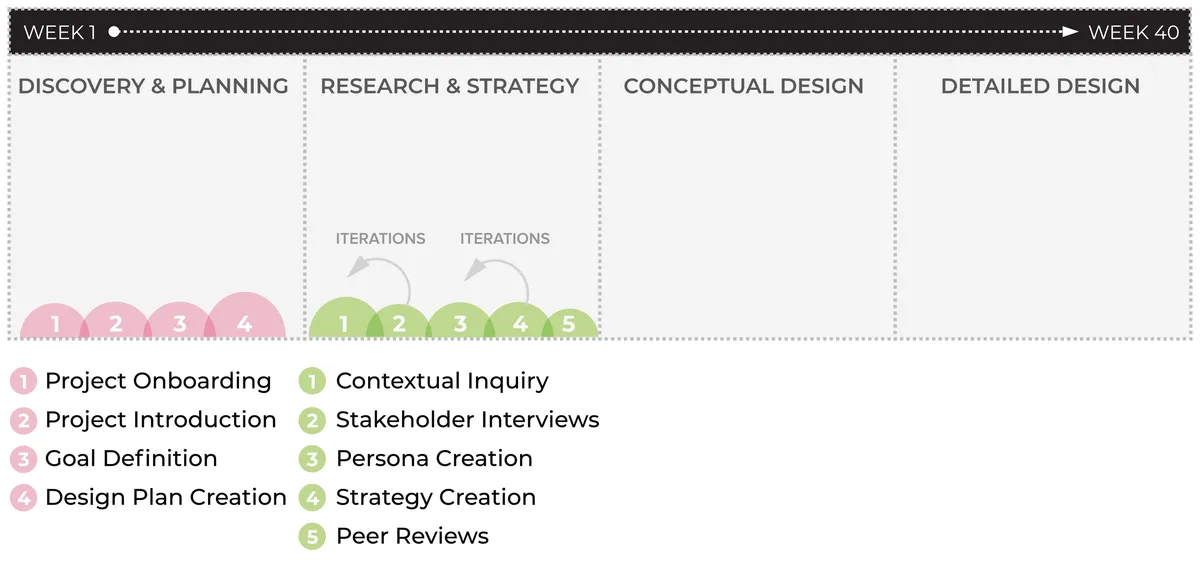
Engagement roadmap: a phased approach spanning discovery, research, strategy, and design, with iterative research and review activities.
1. Establish the direction
The engagement began with project onboarding, stakeholder introductions, goal definition, and design planning. This established a shared understanding of the organisation’s ambitions for patient-centred care and created a plan for investigating the existing service experience.
2. Understand people and work in context
Research combined stakeholder interviews, contextual inquiry, and the development of user stories. Interviews with pharmacists across different locations helped surface frontline perspectives, while contextual inquiry explored the tasks performed by pharmacists and technicians within the actual store environment.
The research also considered four user groups:
- Pharmacists and pharmacy technicians
- Caregivers
- Specialty patients
- Patients managing chronic conditions
Including these groups helped broaden the inquiry beyond a single, generic customer profile. It recognised that the service needed to accommodate different needs, responsibilities, and interactions.
3. Create a shared view of the experience
Discovery and co-creation activities were used to explore user needs and pain points. Personas helped consolidate insights from the research, while customer journey mapping provided a way to connect the different touchpoints involved in the service.
Together, these methods helped frame the experience from the perspectives of both those receiving care and those delivering it.
4. Connect insights to strategic direction
The research was intended to inform a broader vision for the in-store service model, including the relationship between customer experience, frontline workflows, digital services, and business processes.
The roadmap allowed for iterative research and peer reviews as the work progressed from discovery towards strategy and conceptual design. The overall direction was to align the future experience with the organisation’s strategic priorities for patient care.
Deliverables and strategic significance
The engagement developed a foundation for moving towards a more holistic, patient-centred in-store experience.
Key outputs and areas of work included:
- Customer journey mapping: Connecting touchpoints to help understand the broader service experience.
- User research and personas: Organising insights from patients, caregivers, pharmacists, and technicians into useful representations of user needs.
- Discovery and co-creation activities: Exploring pain points and opportunities with the people involved in receiving and delivering pharmacy services.
- Strategic service vision: Establishing an end-to-end direction for a more patient-centred customer experience.
- Proposed business process and technology roadmap: Identifying areas to consider when aligning operational processes and digital workflows with the organisation’s strategic direction.
The strategic value of this work lay in bringing together perspectives that are often considered separately. Patient experience is influenced not only by the quality of an individual interaction, but also by the processes, people, and technology that support it.
By involving frontline staff alongside patients and caregivers, the engagement helped frame pharmacy transformation as a service-design challenge: one that required understanding the experiences of all participants and considering how the wider operating environment could support better care.
The work illustrates how user-centred design can inform enterprise-level decisions by connecting research insights to service strategy, operational workflows, and technology planning. The resulting vision and roadmap were intended to guide future work; they should not be read as evidence that every proposed change was implemented.
Explore other case studies →
AEROSPACE & TECHNOLOGY
AGRICULTURAL FINANCE
CONSUMER GOODS & MANUFACTURING
FINANCIAL SERVICES
RETAIL PHARMACY
SUPPLY CHAIN & LOGISTICS
TELECOMMUNICATIONS
TELECOMMUNICATIONS