TELECOMMUNICATIONS
Designing a Business Mobile Experience
Overview
Mobile and self-service applications need to support different user groups without making complex functionality difficult to understand. In this telecommunications engagement, I worked on UX review and interface design for a consumer self-care portal and a business-facing offer-management application.
The work focused on understanding user needs, improving information architecture and navigation, and developing interface concepts that made key tasks more intuitive for both consumer and business audiences.
The challenge
The engagement involved two distinct audiences: consumers using a self-care portal and business users working with an offer-management application. Each had different expectations, levels of technical familiarity, and task requirements.
The design challenge was to support functional requirements—including drag-and-drop capabilities for the next-generation application—while keeping the interface clear and accessible to non-technical business users.
The experience also needed a more coherent content structure and navigation model, with the interface aligned to the way users understood the services and tasks they needed to complete.
My role
I contributed to the UX review and UI design process, translating business and user requirements into practical interface concepts. My work included exploring user needs, developing personas, reviewing information architecture, sketching task flows, creating interactive prototypes, and defining design guidance for future enhancements.
Engagement approach
The approach connected user understanding with information architecture, navigation, prototyping, and reusable design guidance. Rather than treating the interface as a collection of screens, the work considered how users would move through tasks and understand the application's functionality.
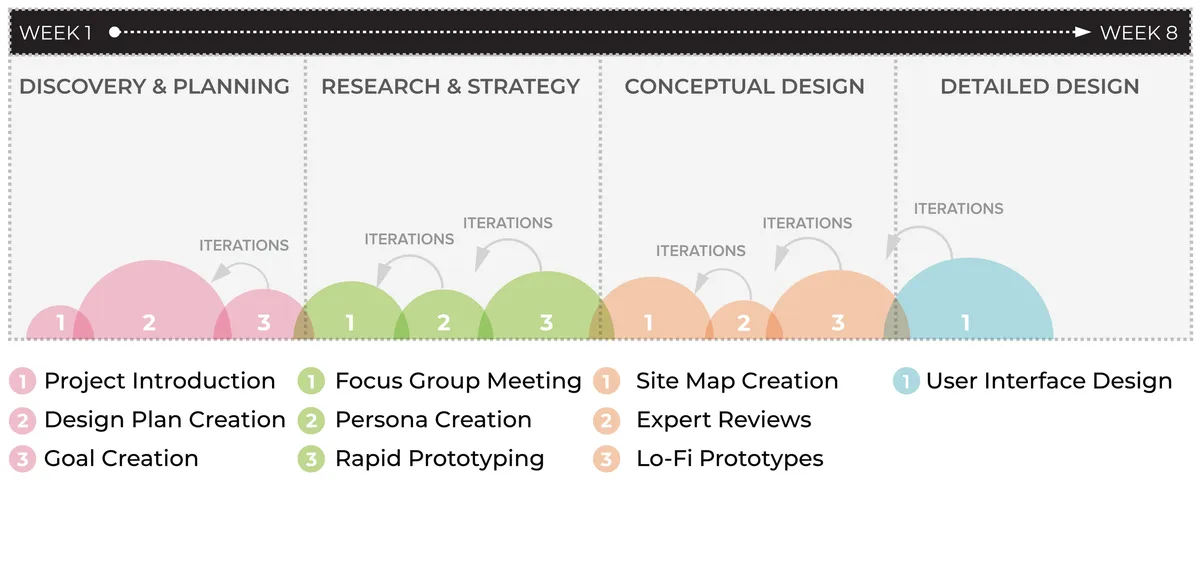
Engagement process: from understanding user needs and task flows to prototyping interface concepts and establishing design guidance.
1. Understand users and their objectives
Persona development helped articulate the demographics, motivations, and needs of Indian telecom users. This provided a foundation for considering how different audiences would approach the self-care portal and related services.
2. Structure information and navigation
The information architecture and navigation model were considered in relation to business functions and user objectives. The aim was to make content easier to understand and key tasks easier to locate, while keeping the experience approachable for business users with limited technical expertise.
3. Explore and validate interface concepts
Paper sketches and interactive prototypes were used to communicate task flows and clarify design concepts. The mobile navigation system was explored through an interface prototype, including how business functions and drag-and-drop capabilities could be presented more intuitively.
4. Establish guidance for future design
A comprehensive design style guide was developed to provide a reference for future UX and UI enhancements. This helped document the intended design direction beyond the immediate concepts and screens.
Deliverables and strategic significance
The engagement produced design work intended to connect user needs with business functionality:
- User personas: Insights into the demographics and motivations of Indian telecom users.
- Information architecture and navigation recommendations: A structure intended to make key tasks and functions easier to understand.
- Task-flow sketches and interactive prototypes: Tangible concepts for exploring navigation, functionality, and interface decisions.
- Mobile interface concepts: Proposed navigation aligned with business functions, including consideration of drag-and-drop interactions.
- Design style guide: Reusable guidance to support future UX and UI enhancements.
The broader significance of the work was its emphasis on making business functionality understandable to its intended users. By connecting personas, task flows, information architecture, and interface design, the engagement addressed usability as a system of related decisions rather than a visual-design exercise alone.
Explore other case studies →
AEROSPACE & TECHNOLOGY
AGRICULTURAL FINANCE
CONSUMER GOODS & MANUFACTURING
FINANCIAL SERVICES
PHARMACY & HEALTHCARE
RETAIL PHARMACY
SUPPLY CHAIN & LOGISTICS
TELECOMMUNICATIONS