RETAIL PHARMACY
Establishing Design Standards for Enterprise Workflows
Overview
Enterprise applications need to support business processes while remaining clear, consistent, and usable for the people who depend on them. In this engagement, I worked with a retail pharmacy organisation on the UX and UI design of a paperless workflow application, helping the team strengthen its approach to usability and establish clearer standards for interface design.
The work combined usability review, task-flow analysis, visual design, stakeholder mentoring, and documentation intended to support more consistent implementation by an offshore development team.
The challenge
The project revealed a gap between the way the team understood user efficiency and the principles of usability engineering. Design and usability practices were not consistently understood across the teams involved, making it harder to assess whether workflows genuinely supported users and their tasks.
The engagement focused on several connected challenges:
- Inconsistent design practices: The team needed a clearer, shared understanding of usability and interface design.
- Workflow issues: Reviews of task flows surfaced fundamental problems that needed to be addressed early.
- Unclear visual hierarchy: Content and colour classification required greater clarity to help users interpret the interface.
- Development consistency: Offshore developers needed a practical reference for implementing interface designs consistently.
The underlying issue was not simply how individual screens looked. It was how usability principles, workflow decisions, and visual design could be applied more consistently throughout the development process.
My role
I provided UX and UI design expertise while mentoring business analysts and other stakeholders involved in the initiative. My role included reviewing the existing usability approach, evaluating task flows, shaping interface design alternatives, and establishing practical guidance for implementation.
I also helped build the team's understanding of human–computer interaction (HCI) and usability engineering, connecting design decisions to the needs of users and the objectives of the business.
Engagement approach
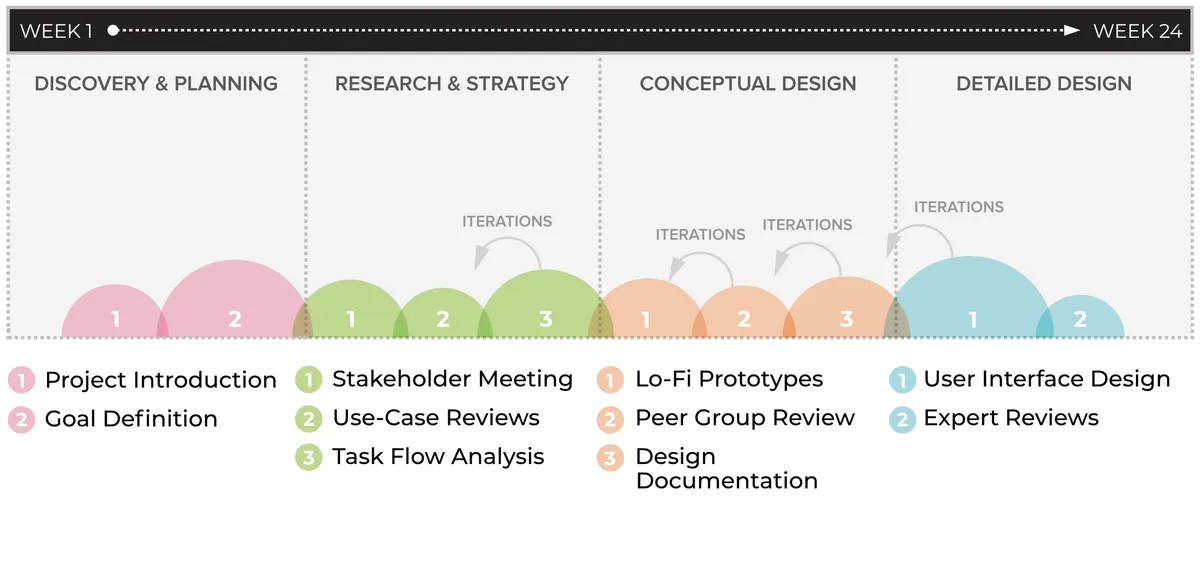
Engagement overview: reviewing workflows, developing consistent UI design guidance, and supporting implementation.
The approach connected three areas of work: usability review, interface design, and knowledge transfer.
1. Review workflows and usability
I reviewed task flows and the existing approach to usability to identify design and workflow issues. This helped bring fundamental problems into view early, rather than allowing them to carry forward into implementation.
The review also provided a basis for discussing what user efficiency should mean in practice: not simply completing a process on a computer, but making the workflow understandable and usable.
2. Develop consistent interface design
I worked on visual design consistency within the application's existing frameworks and styles. This included improving content clarity and colour classification, and developing interface designs that could be interpreted and implemented more consistently.
The objective was to move beyond isolated screen-level decisions towards a coherent set of visual and usability conventions.
3. Document standards and build team understanding
I created a UI design style guide to serve as a practical reference for offshore developers implementing the interface. I also conducted an awareness session for the business analyst team, introducing core usability and HCI principles.
These activities helped connect design decisions with the people responsible for specifying, reviewing, and implementing the application.
Deliverables and strategic significance
The engagement produced design guidance and knowledge-sharing outputs intended to improve consistency across the workflow application and its development process.
Key contributions included:
- Usability and task-flow review: Identified fundamental workflow issues for consideration during design.
- UI visual design: Improved clarity in content presentation and colour classification.
- UI design style guide: Established a documented reference for offshore development.
- Stakeholder mentoring and awareness: Introduced usability and HCI principles to the business analyst team.
The broader significance was the shift from treating usability as an individual design concern to making it a more explicit part of the team's working practices. A shared design reference and stronger understanding of usability principles can help reduce ambiguity between analysis, design, and development.
The engagement illustrates an important principle of enterprise design: consistent user experiences depend not only on good interface decisions, but also on the standards, shared understanding, and implementation practices that support them.
Explore other case studies →
AEROSPACE & TECHNOLOGY
AGRICULTURAL FINANCE
CONSUMER GOODS & MANUFACTURING
FINANCIAL SERVICES
PHARMACY & HEALTHCARE
SUPPLY CHAIN & LOGISTICS
TELECOMMUNICATIONS
TELECOMMUNICATIONS